
Opportunity Zone Tax Incentives: Enhanced and Here to Stay
By Michael Kelley
This article was published in the January 2026 edition of Thomson Reuters' journal Practical Tax Strategies.
Opportunity zones have been a remarkable success story. The legislation was first introduced in 2016 as “The Investing in Opportunities Act” with bipartisan sponsorship in both the House and Senate. A temporary version of the program passed as a late addition to the Tax Cuts and Jobs Act of 2017. In the years since, the Opportunity Zone (OZ) program has successfully leveraged tax incentives to steer investment dollars into the communities that have the greatest need for capital. It is a rare piece of legislation that earned bi-partisan support and is now, as part of the One Big Beautiful Bill Act (OB3), a permanent part of the U.S. tax code with enhanced tax incentives.
New Legislation Resets Tax Planning Possibilities
Newly enacted opportunity zone (OZ) legislation brings about a pivotal moment, as tax professionals and investors who embrace this new law will enjoy a significant tax planning advantage over their peers. In this article, we cover the OZ essentials you need to know.
Some Opportunity Zone Basics
To qualify for opportunity zone (OZ) tax incentives, investments must be made through a Qualified Opportunity Fund (QOF). QOFs report to the IRS and serve as the mechanism through which the IRS monitors OZ compliance. Once a capital gain is realized, it becomes eligible for OZ benefits if invested in a QOF within 180 days. The QOF then reinvests the funds into low-income areas designated as opportunity zones.
OZ tax incentives are broadly accessible—any taxpayer, from individuals to corporations, with a capital gain liability to the U.S. government can participate. While OZ benefits can be applied in various tax planning strategies, the most powerful and widely used feature is the potential to eliminate capital gains taxes for up to 30 years. This works similarly to a Roth IRA in that growth can be tax-free, but without income limits or annual contribution caps, allowing significant sums to gain tax-advantaged status quickly.
OZ incentives involve two types of capital gains and offer two types of benefits. The first gain is the original capital gain, whether from stocks, real estate, cryptocurrency, or other sources, and is eligible for immediate tax deferral and up to 10% permanent tax reduction. The second gain is from the potential appreciation of the QOF, which can qualify for 100% tax elimination after a 10-year holding period, with the benefit lasting up to 30 years from the date of the QOF investment.
The ability to clearly pair the deferral benefit with the original capital gain and link the 100% elimination benefit to the QOF’s long-term appreciation gives the strong foundational framework needed to integrate these incentives effectively into tax strategies.
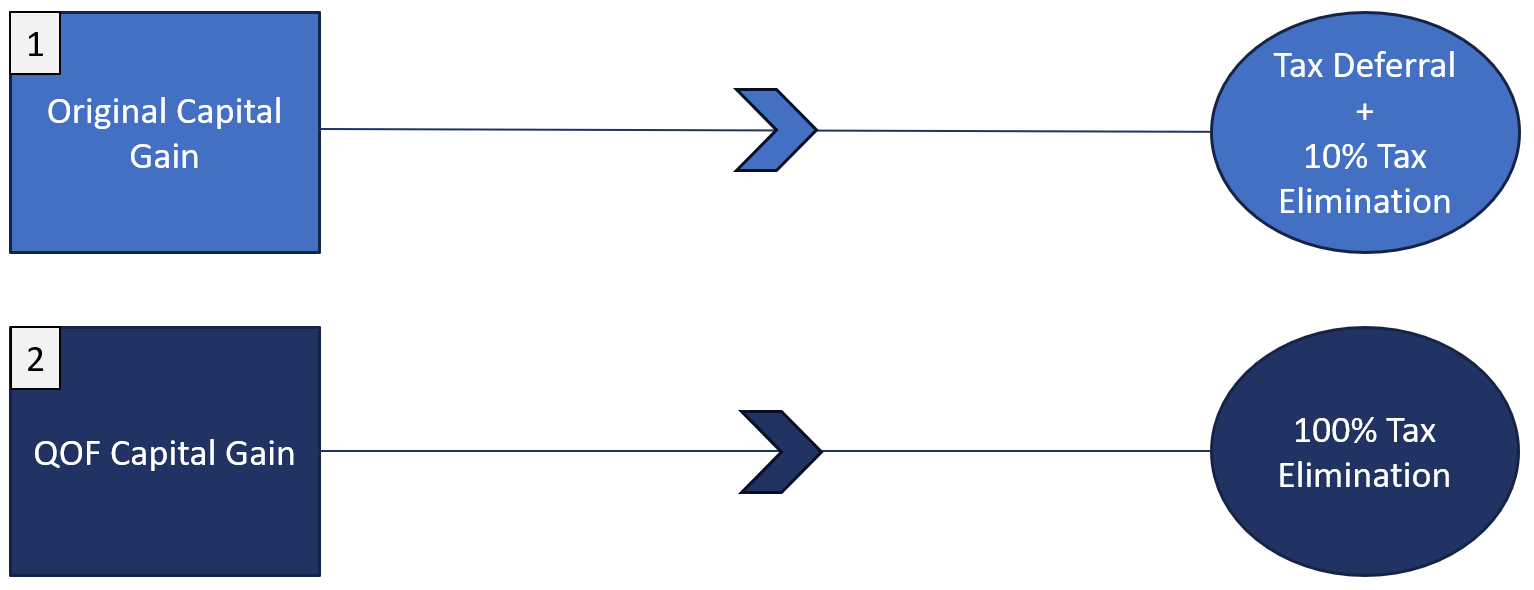
Many investors mistakenly believe that OZ incentives only reduce the tax burden on their original capital gain. This graphic clarifies the proper pairing: the original gain receives deferral and a 10% reduction in tax, while the potential gain from appreciation of the QOF benefits from 100% tax elimination. Recognizing this division is essential for correctly deploying OZ strategies.
One Big Beautiful Bill (OB3) Act’s Three Big Changes to OZ Tax Incentives
- The Opportunity Zone program is now a permanent part of the U.S. tax code.
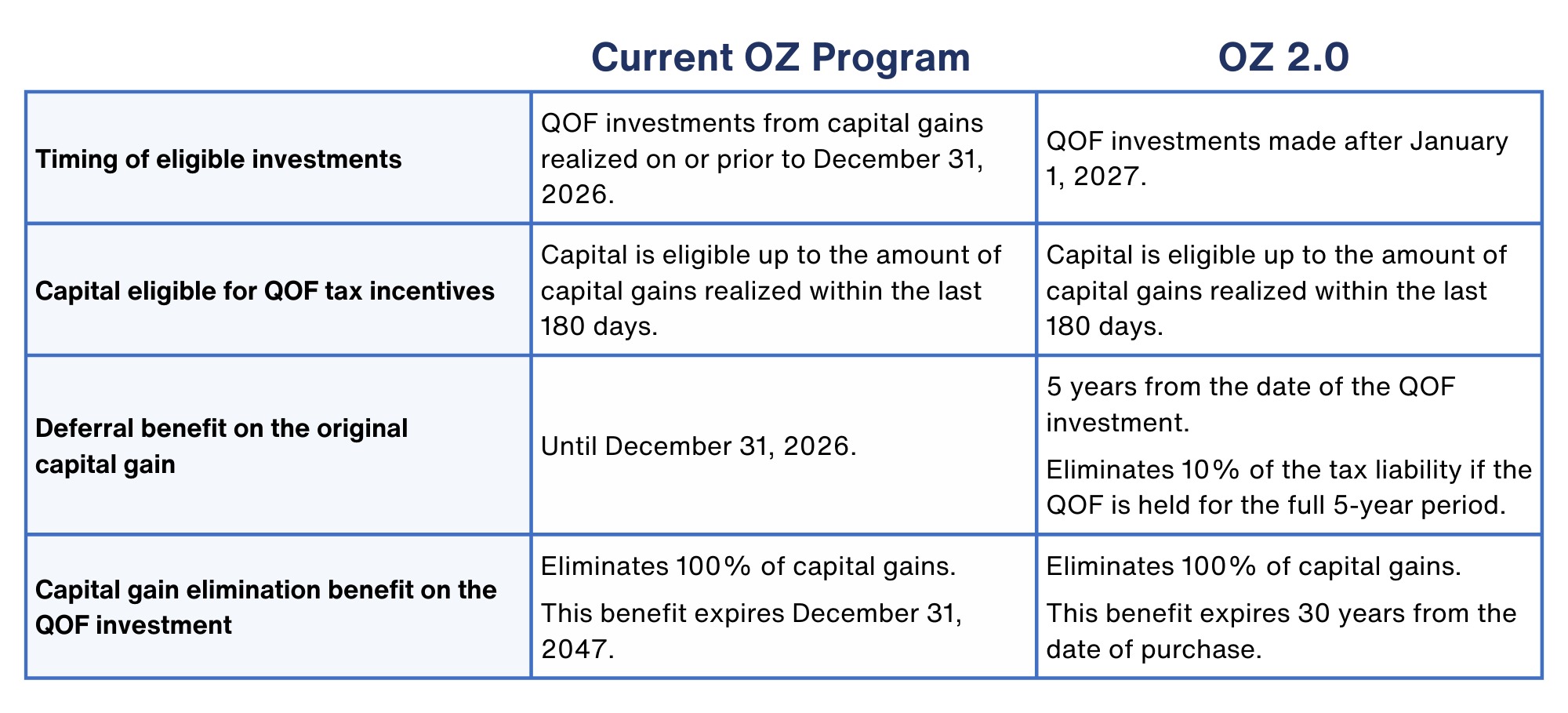
- The tax deferral benefit on the original capital gain now runs 5 years from the date the QOF was purchased. Investors who hold the QOF investment for the full 5 years can also eliminate 10% of their tax liability on that gain.
- The 100% tax elimination on potential QOF appreciation lasts for 30 years from the date of the QOF purchase or the sale of the QOF, whichever comes first. Once investors have held the QOF for 10 years, they can elect to step up their cost basis to 100% of market value, eliminating all capital gains income for tax purposes.
Here is a table comparing the tax incentives offered between the old and new OZ legislation.
How Tax Planners Should Think About the Two Major OZ 2.0 QOF Benefits
The Deferral Benefit
What is it?
The deferral benefit functions like a five-year, interest-free loan from the federal government on the investor’s original capital gains tax, with the potential to eliminate 10% of the liability. While valuable on its own, it can also play a strategic role in a range of tax planning scenarios.
How does it work?
The deferral does not change the character of the original gain. Whether the gain is long-term, short-term, from collectibles taxed at 28%, or from assets taxed at 20%, those tax attributes remain intact. The only change is timing; the recognition of the gain is postponed until the earlier of:
- Five years after the QOF investment, or
- The date the QOF is sold.
Although most investors pair this benefit with a long-term hold strategy, it can also be deployed independently for purposes of short-term tax planning which can be particularly valuable for active investors who may realize capital losses in the future.
Strategic Use Case
- If they pay the tax and later incur a capital loss, they can only carry that loss forward to offset future gains or reduce their taxable income up to $3000 annually.
- If they defer through a QOF and later incur a loss during the deferral period, they can sell an equivalent portion of their QOF investment in the same tax year. This realizes the deferred gain in the same year as the loss, producing a zero percent effective tax rate on that portion of the gain.
- Kept more capital invested and compounding for five years, and
- Qualified for a 10% reduction in the original capital gains tax owed.
Example
An investor sells a position for $100,000, consisting of $80,000 principal and $20,000 gain. They invest the $20,000 gain into a QOF within 180 days, deferring the tax. Over the course of the tax year, they accumulate $1,000,000 of deferred gains in QOFs.
If a $1,000,000 capital loss occurs during the deferral period, they can sell $1,000,000 worth of QOF shares, moving the recognition of the capital gain into the same tax year as the capital loss. Realizing the offsetting gains and losses in the same tax year eliminates the capital gains tax liability entirely.
If the loss never occurs, they still benefit from five years of tax deferral and a 10% reduction in their original tax liability, while keeping more capital invested and working for them throughout.
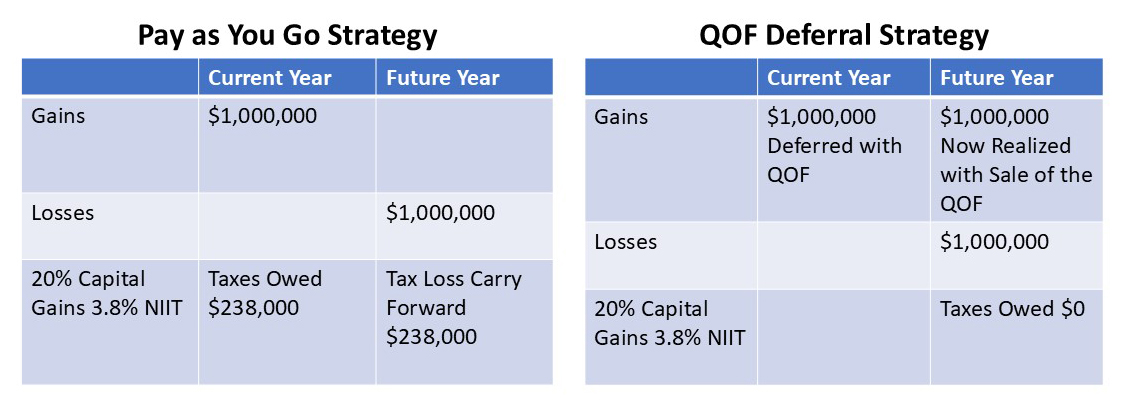
The QOF deferral strategy creates optionality. If a loss happens during the deferral period, you can sell the QOF to realize deferred gain in the same tax year as the loss, eliminating the tax liability. If no loss occurs, you still benefit from keeping the capital working for you for an additional five years with a 10% tax reduction in the initial tax liability.
The Tax Elimination Benefit
What is it?
The most powerful incentive offered to QOF investors is the ability to compound investment growth tax-free for up to 30 years. Like a Roth IRA, this benefit can create substantial long-term wealth and shield assets from future, potentially higher, tax rates. But unlike a Roth IRA, with QOFs there are no annual contribution limits or income restrictions. The only limit is the amount of capital gains realized in the last 180 days.
It is important to note that the 100% tax elimination applies solely to the appreciation of the QOF interest itself. Taxable events generated by the QOF’s operations, such as sales of appreciated properties or income from operations, may still trigger tax. To maximize the “Roth-like” effect, QOFs should seek to:
- Adopt a buy and hold asset strategy to minimize taxable events
- Mitigate ongoing taxable income with interest and depreciation deductions
- Allow investors to remain invested for the full 30-year eligibility window
Whether a client has a $10,000 gain or a $10 million gain, all of it can qualify. This makes the QOF an exceptionally fast way to grow the tax-free portion of a portfolio, potentially achieving in one transaction what would take decades of Roth IRA contributions.
How It Works — Protection Against Future Tax Systems
Once an investor has held their QOF investment for at least 10 years, they can elect to step up its cost basis to the full market value at the time of sale. This mechanism doesn’t just eliminate capital gains tax; it eliminates the capital gain itself.
That is a critical distinction: if future tax laws target capital gains, like the Net Investment Income Tax did back in 2013, there will be no gain to tax. Zero multiplied by anything is still zero. This effectively future-proofs the investment against unknown tax regimes 10, 20, or even 30 years from now.
Because the government’s share of an investor’s savings decades from now is uncertain, increasing the proportion held in tax-free vehicles, like QOFs and Roth IRAs, offers greater certainty about the amount of truly spendable wealth the investor will have the benefit of in the future.
The “Snowball Effect” of Tax-Free Compounding
- In the first 10 years, less than 10% of total potential tax savings are realized.
- The final decades deliver outsized gains, thanks to the compounding effect.
Starting with $100,000, using a 10% growth rate and tax rate of 23.8% for illustrative purposes
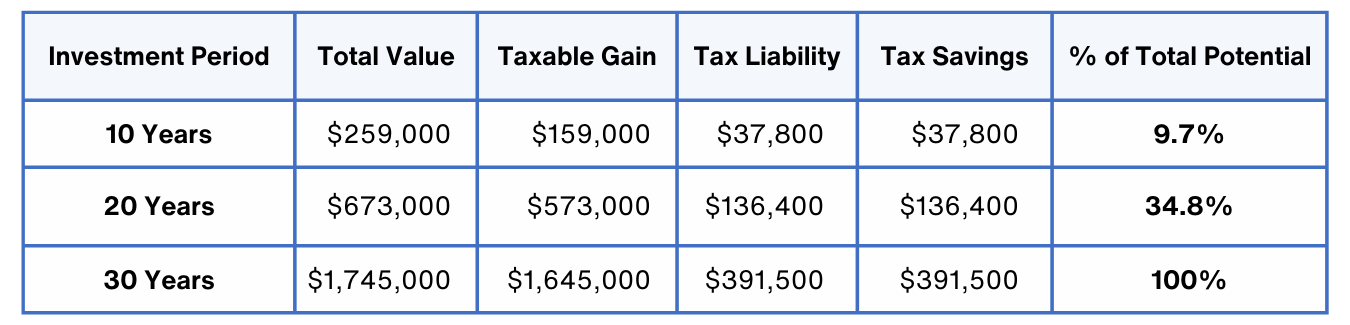
This example shows how the majority of wealth creation and tax savings from a QOF occur after the 10-year mark. At 10 years, an investor captures less than 10% of the potential tax savings, while holding for 20 or 30 years unlocks significantly greater tax savings.
Example: Using the 100% elimination benefit for long-term planning
A 35-year-old investor realizes a $500,000 capital gain and is concerned about future tax increases. To increase their tax-free retirement savings, they invest the gain into a QOF within 180 days, intending to hold for the full 30-year benefit period.
Assuming a 10% annual growth rate:
- At the current combined capital gains and net investment income tax rate of 23.8%, the tax-free compounding generates substantial extra wealth over three decades.
- At a hypothetical future 43.8% rate, the savings are even more pronounced.
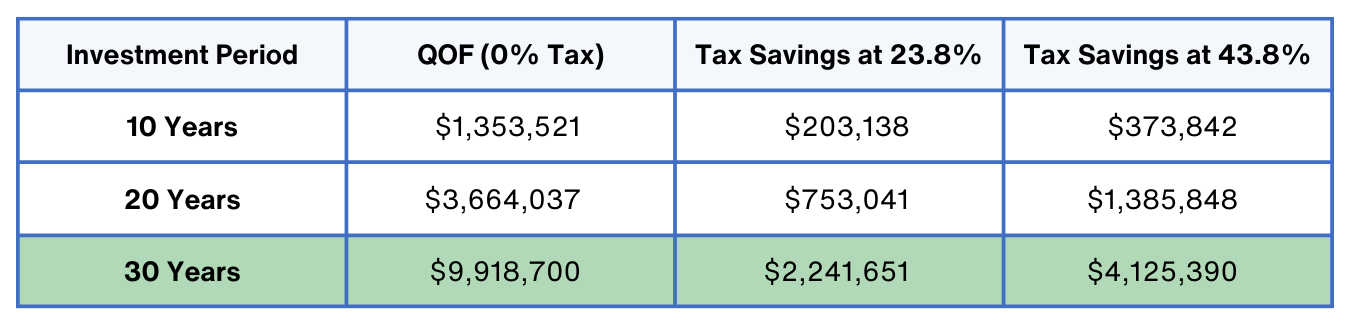
The effect is magnified with time: those last years of compounding contribute significantly to total wealth creation.
For older investors, a QOF can serve as a tax-efficient vehicle for the generational transfer of wealth. If the original investor dies during the benefit period, the beneficiary inherits the QOF and the decedent’s original holding period. For example, if the QOF was purchased 12 years prior, the heir could sell it immediately, free from capital gains tax, or hold for up to 18 more years of tax-free growth.
Qualified Opportunity Funds (QOFs) are Improving
Better accessibility: The first generation of QOFs was very successful and raised more than $100 billion, but they also had significant investment hurdles. As a result, almost all the money invested in the original OZ program’s first few years came from family offices and private equity firms. But now QOFs have the potential to reach a much broader audience of investors. Obstacles that had blocked most investors from participating, such as investor accreditation requirements, lengthy capital lock-ups, high minimum investments, partnership tax complexity, and capital calls have been removed. There are now some QOFs that are publicly traded and can be accessed through a brokerage account.
Better tax planning: The ability of investors to control their holding period in a QOF is essential for maximizing tax incentives and implementing tax plans. The first generation of QOFs was predominately restricted by a fixed ten-year life. This model only allowed investors to capture a fraction of the OZ’s 30-year 100% tax elimination benefit. It also made it impossible to deploy QOF incentives in short-term tax strategies. Now investors have the ability to tailor the use of these powerful tax incentives to suit their unique financial planning needs, both short- and long-term.
Getting to OZ 2.0 – Bridge Strategy
The new OZ legislation has sparked excitement but may also create a “dead zone” as investors delay QOF investments until enhanced incentives take effect in 2027. Funding could be curtailed for more than a year, diminishing capital investments in the very communities the program was designed to support.
Can You Receive Enhanced OZ 2.0 Benefits on Capital Gains Taken Today?
Fortunately, a solution to bridge this investment gap may be provided in the OZ program’s rules. The final OZ regulations are clear that a capital gain deferred by an initial QOF investment, once sold, can be treated as a newly realized capital gain. This includes a fresh 180-day window to continue the deferral by investing in a new or the same QOF. A 2025 capital gain could be deferred with a current QOF investment. The investor could then sell the QOF once some or all of their new investment window allows them to make a new QOF investment on or after January 1, 2027, to receive the enhanced opportunity zone benefits. This could mitigate the “dead zone” problem, restoring the flow of capital to OZ designated communities as originally intended.
Investors need to be aware that although bridging to the enhanced benefits of OZ 2.0 can be very attractive, there may be disadvantages as well.
- The 10-year clock for complete elimination of any capital gain on the QOF resets to zero each time they invest in a QOF. As a result, investors using the bridge strategy will need to stay invested in opportunity zones longer than the normal 10 years to claim this benefit.
- Communities that qualify as opportunity zones under the new QOF regulations beginning in 2027 will have stricter eligibility standards, which could increase the riskiness of the investment. The biggest change is that in order to be eligible, future opportunity zones must have income levels below 70% of the average median income (AMI). The ceiling for current opportunity zones is 80% of AMI.
- Making a short-term “bridge” QOF investment exposes investors to the risks of price volatility.
We believe that the final OZ regulations clearly support the fact pattern we are describing to implement a bridge strategy. Additionally, this strategy is aligned with the purpose of the legislation, which is to keep investment flowing into OZ communities. However, this legislation is brand new, so there is not yet any case law or other signals from the IRS indicating that they agree or disagree with our interpretation of the regulations. We may have better clarity by the time we approach the transition to the enhanced incentives in 2027.
Conclusion
The opportunity zone tax incentives are now permanent and more powerful, making them an indispensable tool for skilled tax planners. QOFs have progressed in making these incentives easier to access. Investors now have the ability to control their holding period, enabling a variety of tax planning strategies. Learning to use a new tax incentive can take time and may fall outside the comfort zone of many individuals, and even some tax professionals. However, when tax laws change, savvy tax planners need to embrace these new tax planning tools and strategies before they fully take effect in 2027.
As seen in Thomson Reuters’ journal Practical Tax Strategies: https://www.thomsonreuters.com/

About the Author
Michael Kelley
His publications appear regularly in Thomson Reuters journals, including Practical Tax Strategies, Real Estate Taxation, and Estate Planning, as well as The CPA Journal, Thomson Reuters’ Checkpoint and Westlaw databases, and Kiplinger’s Tax Planning and Adviser Intel columns. He has also trained over 10,000 CPAs and enrolled agents through continuing education courses focused on Opportunity Zone tax planning strategies.
Read more about the author in his biography.
Investing in Opportunity
Materials provided by Park View OZ or our affiliates have been prepared for informational purposes only and are not intended to provide or be relied on for tax, legal, or financial advice. You should consult your own tax and legal advisors before engaging in any transaction.